The “Ghost Kitchen” Gamble: Why Your Premium Order Might Be a Hygiene Nightmare
The Investigation: A Simple Experiment.
A simple way to peel back the curtain is to check the addresses on your food delivery app right now. Search for “Gourmet Burger” in your area. Note the address. Now, search for “Budget Momos.” Check that address too. Don’t be surprised if they are exactly the same.
You might think you are choosing between a premium bistro and a street-side stall. In reality, you might be ordering from “Kitchen No. 4″—a single facility churning out 14 different brands from one fry station.
Welcome to the Ghost Kitchen economy. It is a world of extreme variance. And right now, without a physical dining room to inspect, you are flying blind.
What is a Cloud Kitchen?
A Cloud Kitchen (or Ghost Kitchen) is a cooking facility with no physical dining space. It exists only as a digital storefront. This model isn’t inherently bad. In fact, it’s brilliant. It lowers overheads and allows for lower prices. But it introduces a dangerous variable: The lack of visibility.
The Illusion of Choice (A Composite Reality)
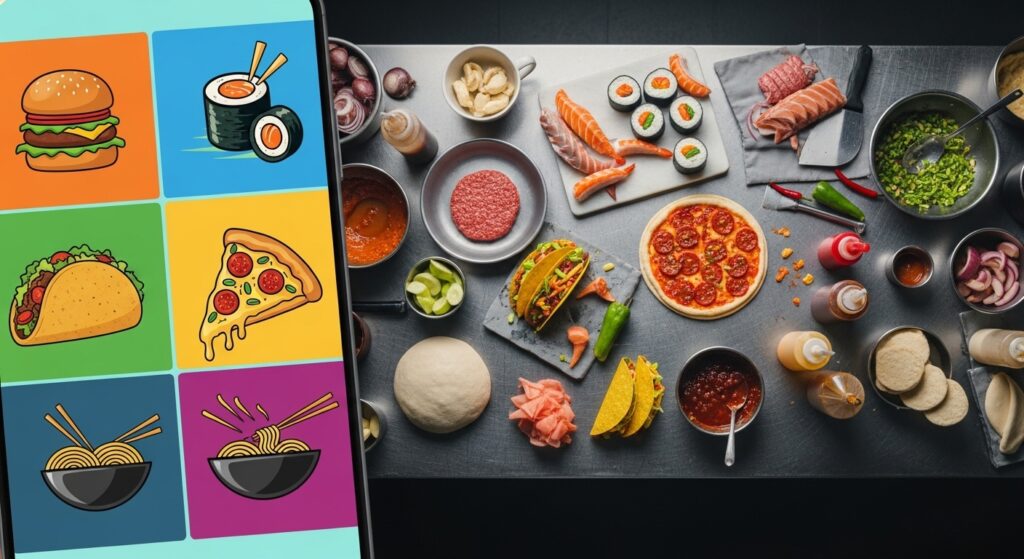
Let’s look at a typical “Kitchen Hub” setup found in areas like Gurgaon’s Udyog Vihar or Mumbai’s Andheri East. Imagine a long corridor lined with small metal shutters. Behind Shutter 4, you might find a single team managing orders for five different “brands.”
One tablet pings for a “Healthy Salad.” Another pings for “Spicy Wings.” In a high-pressure environment, cross-contamination is a real risk.
The “Brand Illusion” works like this: On your app, you see distinct restaurants with unique logos and vibes. In reality, they might share the same fridge, the same oil, and the same prep table. This isn’t illegal. It’s “efficiency.” But it begs the question: Is the “Premium Italian Bistro” really premium, or is it just the “Budget Pizza Place” wearing a tuxedo?
The Industry Reality Check The Indian cloud kitchen market GMV (Gross Merchandise Value) has surged past ₹16,500 Crores as of 2026 (Strategy&/RedSeer). However, rapid growth brings chaos. Under the “Eat Right India” initiative, the FSSAI conducted special drives in 2022 and 2023, scrutinizing thousands of licenses in Delhi, Mumbai, and Bengaluru to shut down non-compliant “Dark Kitchens.”
The Economics of Cutting Corners
Why do some operators cut corners on hygiene? It’s not always malice. It’s math.
Here is the “Margin Squeeze”: To list on a major platform (Zomato/Swiggy), a restaurant often pays commissions ranging from 20% to 30% per order. Add discounts to attract customers. Add the cost of packaging (that gold foil isn’t free). Add raw material costs.
If you pay ₹200 for a burger:
- ₹60 goes to the App.
- ₹70 goes to Ingredients.
- ₹40 goes to Rent/Packaging.
That leaves roughly ₹30 for profit, staff, electricity, and… cleaning supplies. When margins are that thin, the first thing to go is the “non-essential.” At the lower end of the spectrum, operations may lack the segregation of duties found in professional hubs. Without the pressure of a visible dining room, maintaining high sanitation standards depends entirely on internal discipline rather than customer scrutiny.

The Human Anchor: Meet “Raju”
I spoke to a delivery partner we’ll call Raju, who operates in South Delhi. He wasn’t dramatic. He was just tired. “Sir,” he said, leaning on his bike, “I pick up from some places where I wouldn’t even drink a glass of water.”
He explained that while the big “Kitchen Hubs” are usually strict, the smaller, independent “fly-by-night” kitchens are the problem. “Sometimes it’s just a basement. No ventilation. The smell of old oil sticks to your clothes. But the customer only sees the fancy bag I hand them.”
Raju eats at a local dhaba. He knows the owner. He sees the food being cooked. That’s the difference.
[AI ART PROMPT] Documentary style, low-angle shot of a delivery rider sitting on his bike in the rain at night. He looks exhausted. In the background, a blurred, neon-lit sign of a “Cloud Kitchen Hub” glows ominously through the mist. Raindrops on the camera lens reflect the red taillights.
The “Hygiene Gap”
When you walk into a restaurant, you perform a visual audit instantly. Dirty table? You leave. Smelly waiter? You leave.
But on an app, the “Visibility Loop” is broken. You rely on:
- Photos: Which are professionally shot.
- Ratings: Which reflect taste, not hygiene.
- FSSAI License: Which is mandatory, but inspectors can’t be everywhere at once.
The FSSAI does have a “Hygiene Rating Scheme” where kitchens can voluntarily get audited by third parties.
- 5 Stars (Smile Plus): Excellent.
- 4 Stars (Smile): Very Good.
- 3 Stars: Good. But how many times have you checked for that specific badge before ordering? Most of us just look at the “App Stars.” And a 4.5-star rating usually means “Tasty,” not “Safe.”
The “Aadhaar of Food” Update
There is some good news. Regulators are catching up. Recent mandates now require the FSSAI License Number to be printed on every bill and displayed on the app. This is like the “Aadhaar” for your food. If you check that number, you can see exactly who owns the kitchen and where it is located—cutting through the “Brand Illusion.”
[AI ART PROMPT] Close-up, macro shot of a “gourmet” burger sitting on a stainless steel counter. The lighting is harsh. Next to the burger, the counter has visible grime and scratches, hinting at a lack of deep cleaning. High contrast, investigative style.
Now What?
The Cloud Kitchen industry isn’t going away because it is simply too efficient to fail. And honestly, many of them serve incredible, safe food from state-of-the-art facilities. But the “Wild West” era of unregulated sheds needs to end.
The Consumer Safety Checklist:
- [ ] Google the Address: If 15 restaurants are listed at the exact same location, it’s a cloud kitchen. Proceed with caution.
- [ ] Check the License: Scroll to the bottom of the restaurant page. No FSSAI number? Do not order.
- [ ] Look for the Badge: Use the FSSAI “Hygiene Rating” filter. Look for 4 or 5 stars (Smile/Smile Plus).
- [ ] Verify Physical Presence: Does the brand have at least one dine-in outlet? Hybrid brands tend to have stricter SOPs.
Next time you see a new “premium” brand pop up with zero reviews, pause. Ask yourself: Are you buying a meal, or are you buying a marketing campaign?
What happens next depends on choices made today.