It is 11:15 PM on a suffocating Tuesday in Gurugram.
Amit, a 28-year-old software developer, stares at his state utility app.
His prepaid electricity balance has just hit zero.
A quiet “Latching Relay” inside his digital meter safely disconnects the supply to his apartment, preventing any electrical arcing.
He recharged the wallet with ₹3,000 just two weeks ago.
His first instinct is to assume the new digital box on his wall is running fast, or worse, completely rigged.
But the reality of his shrinking balance is not a technical glitch.
It is the quiet, nationwide rollout of the new Time of Day Tariff.
Millions of Indian households are experiencing this exact digital culture shock as we shift to a pay-as-you-go grid.
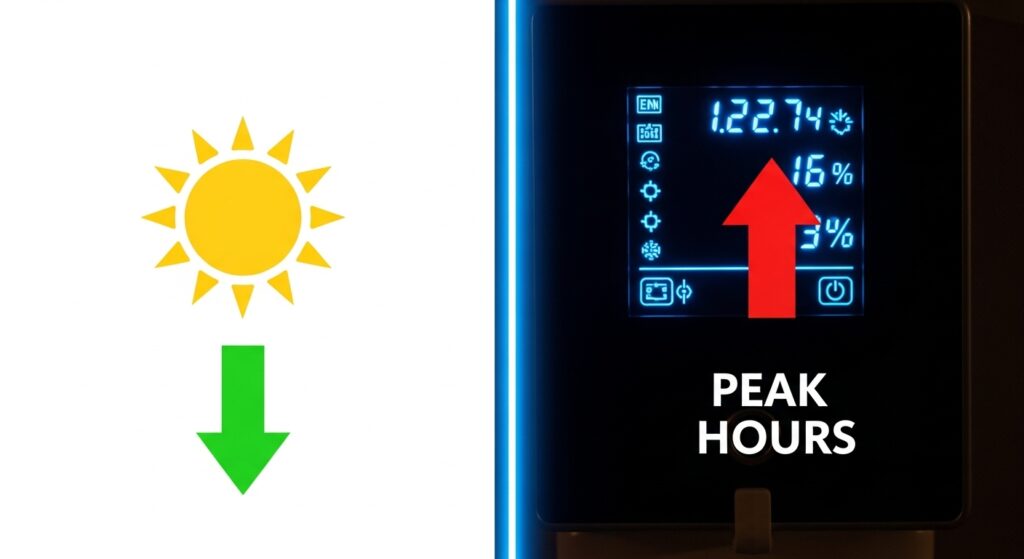
What exactly is the Time of Day Tariff?
It is a dynamic billing structure where the cost of electricity changes based on the hour of consumption. Instead of a flat monthly rate, power is discounted by roughly 20% during daytime solar hours, but carries a 10% to 20% surcharge during peak evening hours.
Let’s address the biggest myth immediately: the idea that smart meters “run fast.”
People swear their consumption hasn’t changed, yet their bills are higher.
The truth lies in a concept called “Phantom Load.”
Old mechanical meters had a high “Starting Current Threshold.”
They physically couldn’t register tiny, continuous power draws—like your TV on standby, a plugged-in phone charger, or a Wi-Fi router.
Smart meters capture every single watt. Your consumption didn’t increase; the hardware just stopped ignoring the leaks.
Furthermore, sudden balance drops are often just “Legacy Arrears.”
States like UP and Haryana use the new meters to automatically recover unpaid balances from your old mechanical meter over 6 to 12 monthly installments.
Consumer Protection Fact: The Disconnection Window While prepaid meters disconnect at zero balance, DISCOM guidelines generally prohibit automatic disconnections between 6:00 PM and 10:00 AM, or on public holidays. This legal safeguard ensures families are not left entirely in the dark overnight during a crisis.
To understand why the grid is changing, we have to look at the macro-economics of power.
When we looked at the load-curve data for North India’s summer peaks, the math became undeniable.
The grid is under absolute siege between 7:00 PM and 11:00 PM.
Our state distribution companies (DISCOMs) are managing over ₹6 Lakh Crores in debt.
Historically, the country has suffered massive Aggregate Technical & Commercial (AT&C) losses—the official term for unbilled electricity and transmission leaks.
The government’s goal is to slash these AT&C losses from roughly 20% down to a manageable 12-15% by 2025.
To survive, the grid needs load balancing.
Think of it like dynamic pricing at a multiplex.
A Friday night blockbuster costs ₹500, but a Tuesday morning matinee is ₹150.
This is exactly how the Time of Day Tariff works for your home appliances.
They want you to shift your heavy usage to the afternoon when renewable solar energy is abundant and cheap.
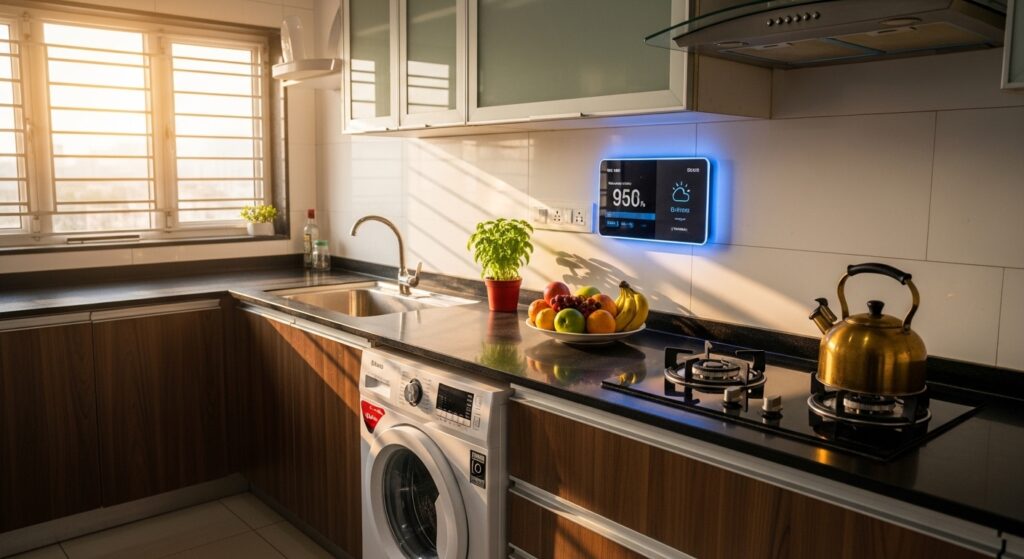
But at the household level, this creates a fascinating logistical puzzle.
If you work a standard job, your house is mostly empty during those discounted solar hours.
You only return home and turn on your heavy appliances at night—exactly when the surcharge hits.
So, what is the immediate solution for the average consumer?
You have to learn behavioral grid hacking.
Instead of blasting the AC at 9 PM during peak rates, smart consumers use “Thermal Pre-cooling.”
They cool the room at 3 PM during discounted hours, seal the windows, and let the walls release the chill at night.
You also need to monitor your 15-minute usage intervals on the official DISCOM app, a technical standard built into the new Head End Systems (HES).
Legal Redressal: The CGRF If your prepaid balance is deducted incorrectly, you do not have to argue endlessly with a chatbot. Every citizen has a legal right to escalate technical billing disputes directly to their local Consumer Grievance Redressal Forum (CGRF) for an official audit.
This infrastructure upgrade is permanently changing the relationship between the citizen and the state utility.
The era of unquestioned, flat-rate electricity is officially over.
Mastering the math of the Time of Day Tariff is no longer just for commercial factories; it is a basic household survival skill.
Will consumers adapt their habits to the new grid, or will the cost of peak comfort become a new luxury?
What happens next depends on choices made today.
Stay informed. Question what you hear. Follow for more deep-dive explainers.
The Redline Media Debrief: Key Takeaways
What is the core mechanism of the Time of Day Tariff? It is a dynamic billing structure where electricity rates carry a 10-20% surcharge during peak evening hours, balanced by a roughly 20% discount during daytime solar hours to encourage grid load balancing.
How can I manage my bills under the Time of Day Tariff? Audit your Legacy Arrears, track your Phantom Load, utilize Thermal Pre-cooling during the day, and escalate incorrect automated deductions to the CGRF.
Read More Investigation here