It is 8:30 PM on a Tuesday at a crowded cafe in Indiranagar, Bengaluru.
Rhea (name changed for privacy), a 26-year-old financial analyst, is “ghost-scrolling” through her phone.
She just went on her 14th first date of the year.
The guy spent thirty minutes talking about his crypto portfolio, didn’t ask her a single question, and then asked to be added to her Instagram Close Friends list.
She opens her phone, stares at a grid of hundreds of generic faces, and hits ‘Uninstall’.
This is not just millennial burnout.
This is a generation-wide breaking point.
It is a mass, quiet escape from Dating App Fatigue.
Millions of young Indians are rebelling against the endless swipe.
And they are running straight back into the arms of structured matrimony. But it is not what you think.
What is Dating App Fatigue?
It is the psychological exhaustion caused by endless, gamified swiping without meaningful human connection. It happens when tech platforms treat your love life like a slot machine, keeping you addicted to the hunt while leaving you emotionally hollow. The core symptom of Dating App Fatigue is feeling entirely alone in a crowded digital room.
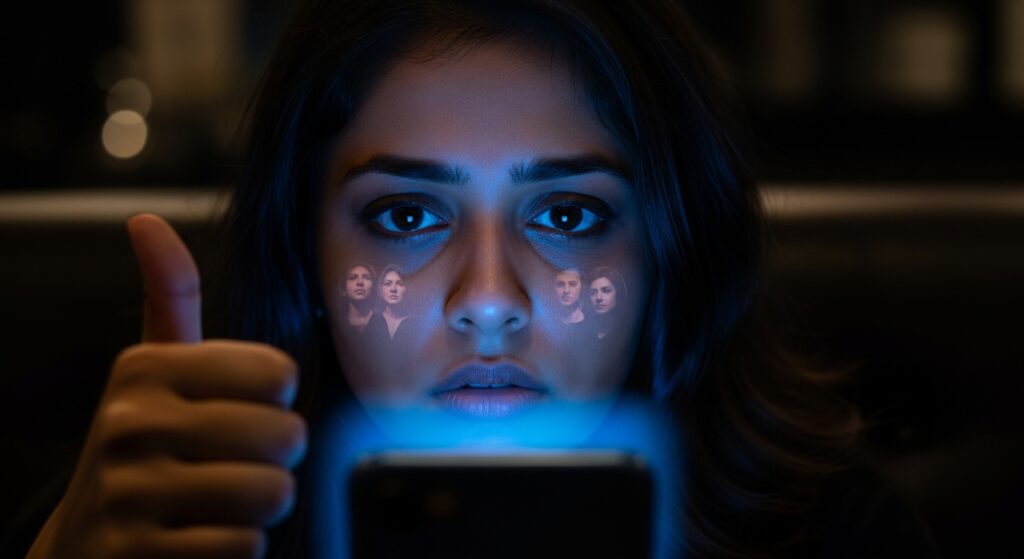
Here is the uncomfortable reality we debated in the newsroom.
India has tens of millions of active users across casual swiping platforms.
But you and your friends are more isolated than ever.
So what does that actually mean?
It means there is a fundamental misalignment of business incentives versus user goals.
Data File: SEC Filings & Industry Reality (Released Feb 2026) Match Group’s February 2026 report reveals a complex shift. Tinder’s payer base fell by 8% to 8.77 million users. Meanwhile, high-intent apps like Hinge saw revenue surge 26% to $186.5 million. Simultaneously, Anupam Mittal confirmed that on Shaadi.com specifically, over 70% of new profiles are now self-created by the users themselves, rather than parents.
If you meet your soulmate on day one, the corporation loses a paying customer.
Critics and former engineers point out that the business model creates a subtle conflict of interest.
The algorithm is incentivised to optimize for “Time to Next Date” rather than “Time to Delete.”
Think of it like the Silk Board traffic jam during monsoon—a notorious two-hour gridlock in Bengaluru.
The app is the toll operator.
If the road is actually clear, you stop paying for the premium, fast-track lane.
This subtle, systemic friction is the silent engine driving Dating App Fatigue.
The Psychology Fueling Your Dating App Fatigue
Forget the conspiracy theories about corporate sabotage.
The real culprit is a proven psychological mechanism called the Variable Reward Schedule.
It is the exact same behavioral loop used by casino slot machines.
You don’t win every time you pull the lever. You win just often enough to keep pulling.
The app might show you a fantastic, highly compatible profile on Monday.
Then, it buries you in mediocre, incompatible matches until Thursday.
You are constantly chasing the next hit, which inevitably leads to severe Dating App Fatigue.
I spent the better part of a Saturday dissecting this with a behavioral economist.
They pointed me to psychologist Barry Schwartz, who coined the term “The Paradox of Choice.”
Schwartz proved that when you give a human brain infinite options, it triggers “Decision Paralysis” and “Maximizer’s Regret.”
Imagine walking into a massive, 500-dish wedding buffet.
You load your plate with biryani, pasta, and sushi.
By the time you sit down, nothing tastes good because the flavours clash and your palate is overwhelmed.
That is exactly what your brain experiences when you swipe on fifty people in ten minutes.
Nobody feels special anymore.
You are shopping for human beings on a digital conveyor belt, accelerating your Dating App Fatigue.
Let’s look at how quickly we got here.
- 2014: Swiping enters India, marketed as the ultimate symbol of youth freedom.
- 2020: The pandemic forces everyone online, creating peak casual app usage.
- 2026: A mass exodus occurs as Gen Z shifts capital and time toward intentional dating.
What most people miss is why Gen Z is suddenly pivoting to matrimonial websites.
It is not a return to conservatism or family pressure.
It is a rebellion against algorithmic loneliness.
Young techies in Gurugram and Mumbai are looking at the casual dating market and realising the casino always wins.
So they are simply cashing out and walking to a different table, desperate for a cure to Dating App Fatigue.

They are not asking their retired uncles to forward blurry photos on WhatsApp.
They are creating and managing the profiles themselves.
The modern “Bio-Data” acts as a brutal, highly efficient filter, serving as the ultimate antidote to Dating App Fatigue.
The Matrimony Shift: High-Intent Filtering Modern digital bio-datas bypass algorithmic matching by forcing absolute clarity. By listing salary brackets, career ambitions, and non-negotiables upfront, users eliminate the three weeks of exhausting small talk that casual platforms rely on for daily active engagement.
No more “Hey, what are you looking for on here?” stretching out for days.
It is treated like a business merger of two lives.
And for a generation that is collectively exhausted, this radical transparency is the only way to beat Dating App Fatigue.
Let’s look back at Rhea.
On a casual app, she was trapped in a system weaponising Dating App Fatigue.
On a high-intent matrimony platform, the men reviewing her profile are actually ready to build a life.
The intent is aligned from the very first click.
We were sold the lie that technology would make finding love effortless.
Instead, it turned the ‘vibe check’ into a subscription tier.
By escaping Dating App Fatigue, Gen Z is simply taking their humanity back.
The next phase isn’t just deleting apps; it’s the rise of “Stealth Connections”—private, vetted circles where the algorithm has no seat at the table.
What happens next depends on choices made today.
Stay informed. Question what you hear. Follow for more deep-dive explainers.
The Redline Media Debrief: Key Takeaways
What triggers Dating App Fatigue? It is triggered by the paradox of choice, endless swiping, and variable reward schedules that optimize for “Time to Next Date” rather than finding a lasting match.
How do you cure Dating App Fatigue? Indian millennials are abandoning casual swiping for high-intent matrimonial platforms, setting strict digital boundaries, and demanding upfront radical honesty to bypass the variable reward loop entirely.