The Ghost in the Server Room
I spent the better part of a Saturday morning reviewing technical whitepapers on “Supply Chain Interdiction.”
It sounds like dry, corporate jargon. But in the context of the recent U.S./Israel-Iran escalation, it is the ultimate structural vulnerability.
Some cybersecurity frameworks suggest investigators are looking closely at supply-chain malware. Recent Mandiant reports tracking state-sponsored actors like UNC1549 highlight their use of advanced, custom backdoors such as DEEPROOT and TWOSTROKE.
We debated this in the newsroom: what is the true cost of unverified infrastructure?
If a dormant exploit is embedded deep in a system’s firmware, it exists below the operating system level. It’s waiting for a specific “wake-up” signal.
Advanced malware families like DEEPROOT operate so deep that standard software scans cannot see them, requiring rigorous forensic analysis.
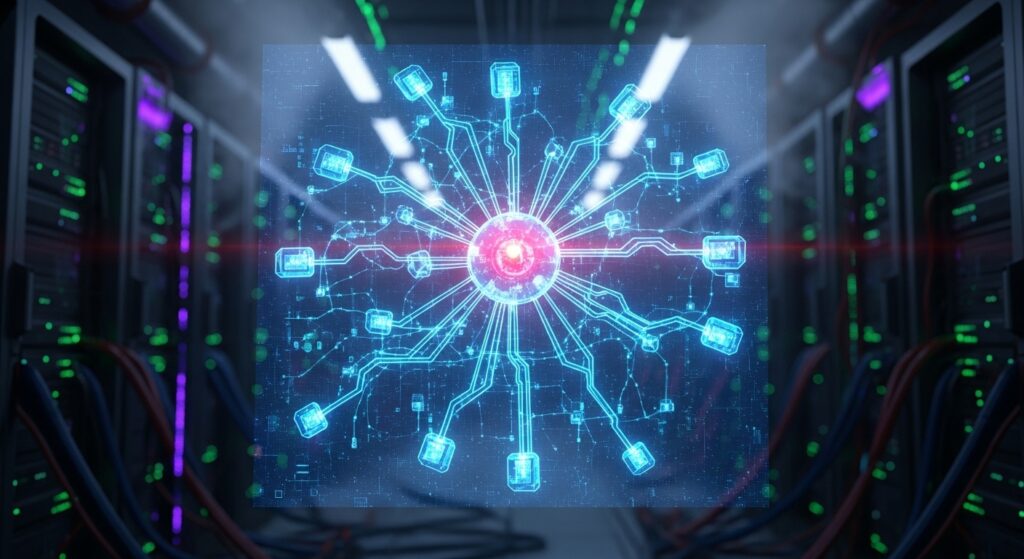
The Centralization Trap: The Hub-and-Spoke Flaw
For years, Tehran championed its National Information Network (NIN) as a way to achieve “digital sovereignty.”
The goal was to create a “Sovereign Intranet” that kept domestic data safe from Western influence. However, network architects have long warned that this specific hub-and-spoke model is deeply flawed.
By forcing all traffic through a few centralized hubs, the state inadvertently built a massive vulnerability.
During the February 28, 2026 conflict, this centralized architecture allowed the regime to seamlessly execute a near-total internet blackout through gateways managed by the Telecommunication Infrastructure Company (TIC)—the state-owned monopoly on international bandwidth—instantly isolating the population.
Blinding the Radar: The CEW Factor
If you are a military commander, you rely on your radar and communication links to see the battlefield.
But what if your sensors were actively lying to you?
Cyber-security experts note that the recent strikes likely involved DRFM (Digital Radio Frequency Memory) Deception. This is a Physical Layer (RF) manipulation, an advanced Electronic Warfare (EW) technique.
It captures an incoming radar pulse, modifies it, and retransmits it to create “false targets.”
Think of it like a funhouse mirror for radio waves. While the operator sees a quiet sky on their monitor, the actual RF signature is being distorted and spoofed. By the time the deception is realized, the tactical window has closed.
The Global Stakes of digital warfare in the Middle East
The procurement of fiber-optic cables and switching gear has turned into a primary national security headache.
In digital warfare in the Middle East, citizens may not be the direct target, but the loss of electricity grids and communication networks turns the population into collateral damage.
Between 2021 and 2024, infrastructure projects across the region saw a massive surge. Analysts now warn that billions of dollars worth of legacy infrastructure may harbor undetected vulnerabilities.
These aren’t just software bugs; they are structural risks. While firmware-level mitigations can sometimes help, deep-seated supply chain compromises are notoriously difficult to remediate.
The Logic Over Lead Doctrine
The strategy behind modern digital warfare in the Middle East suggests that ‘Kinetic’ strikes are increasingly preceded and amplified by ‘Logic’—the malicious scripts that blind defenses.
If you can disable the cooling system of a power plant or spoof the communication frequency of a missile battery, the battle is won before the first jet even takes off.
The Indian Connection: Why The Wires Matter
India has nearly 1 Crore (10 million) citizens living and working in the Gulf region.
Their daily lives—banking, travel, and communication with their families back home—are entirely dependent on the digital stability of that region.
As the Ministry of External Affairs (MEA) noted while activating emergency protocols on March 1st, digital disruptions pose a direct threat to the coordination of citizen evacuations.
They activated a special control room operating 9 AM to 9 PM and issued urgent security and travel advisories through local embassies for the 1 Crore stranded citizens.
For families back home, the sudden silence on their WhatsApp groups is a terrifying reality.
Securing the Future: The DoT Mandate
India has already taken proactive steps to avoid this exact vulnerability.
The Department of Telecommunications (DoT) operates the Trusted Telecom Portal. It mandates that service providers—especially those building out 5G and 6G infrastructure following the January 27, 2026, India-EU Summit agreements and the Towards 2030 Comprehensive Strategic Agenda—only use equipment from verified sources.
This agreement allows Indian integration into European defense value chains, which is why the DoT mandate carries so much weight.
Through this portal, India ensures that critical infrastructure is sourced from vendors who have undergone intense security vetting, minimizing the risk of supply-chain sabotage.
The real cost isn’t just in compromised servers or downed radars. The fallout of digital warfare in the Middle East hits home, leaving millions of families disconnected, waiting in the dark for a message that might never arrive.
Dive Deeper into The Redline Media Data
This is just one thread in the larger web. We track the systems, the money, and the power driving the headlines.
Explore our full archive of uncensored investigations:
[REPORTS – https://theredline.media/reports]
The world is redlining. Command the narrative.